🧩 Introduction: Why SRE Is Ripe for AI Disruption
Site Reliability Engineering (SRE) has become the backbone of modern infrastructure management, but it comes at a cost.
SRE teams are overloaded with:
- Alert fatigue from fragmented monitoring tools
- Time-consuming root cause analysis (RCA)
- Constant fire-fighting instead of proactive planning
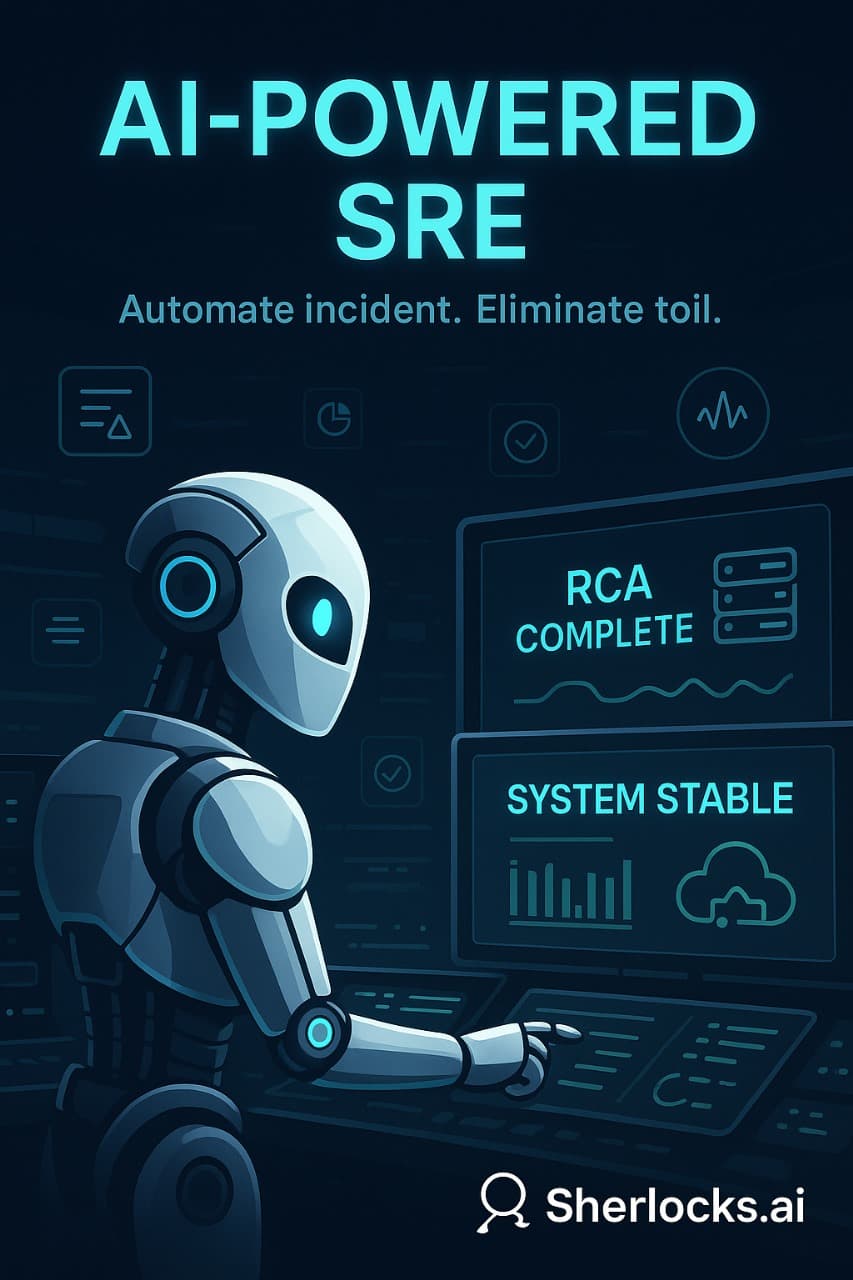
This is where Sherlocks.ai steps in an AI-native SRE assistant built to automate incident response, prevent outages, and deliver intelligent RCA autonomously.
🔧 The Problem: Traditional SRE Is Manual, Reactive, and Draining
Despite sophisticated observability stacks, most teams still rely on:
- Manual correlation of logs and metrics
- Human-led war rooms
- Reactive firefighting with little time for long-term improvements
This leads to:
- Wasted engineering time
- Prolonged MTTR (mean time to resolution)
- Burnout and missed SLAs
🤖 The Solution: Sherlocks.ai’s Autonomous SRE Agents
Sherlocks.ai replaces reactive workflows with AI-powered automation. Here’s how:
🧠 1. 24/7 Autonomous SRE Agent
- Continuously monitors system signals
- Predicts and prevents high-severity incidents
- Operates without human intervention
🔍 2. AI-Driven Root Cause Analysis
- Automatically correlates logs, metrics, and traces across services
- Identifies probable root causes within seconds
- Offers explainable RCA insights to engineers
🚨 3. Real-Time Incident Response Automation
- Detects anomalies in real time
- Triggers playbooks and remediation without escalation
- Learns from past incidents to improve autonomously
📈 The Benefits of Sherlocks.ai for DevOps Teams
| Benefit | Impact |
|---|
| 🛑 Reduced Alert Noise | Sherlocks filters out 90%+ of non-actionable alerts |
| ⚡ Faster RCA | Shrinks RCA time from hours to minutes |
| 🧘 Less Toil | Automates repetitive investigation tasks |
| 🔒 Higher Reliability | Improves uptime and reduces SLA breaches |
| 💸 Operational Efficiency | Frees up engineers to focus on core innovation |
🏢 Real-World Use Case
A global SaaS provider integrated Sherlocks.ai into their incident management pipeline.
Results in 6 weeks:
- 40% reduction in MTTR
- 80% decrease in escalations
- 2x improvement in SLA adherence
Their SRE lead said:
“Sherlocks turned our war rooms into watch towers. We finally have space to build, not just fix.”
🚀 Why Sherlocks.ai Is Built for the Modern Infrastructure Stack
Unlike rule-based automation tools, Sherlocks:
- Understands service graphs contextually
- Works across cloud-native architectures (Kubernetes, serverless, multi-cloud)
- Integrates with your existing observability tools (Datadog, New Relic, Prometheus)
See how Sherlocks compares to traditional observability platforms like PagerDuty, New Relic, and Datadog.
🔮 The Future of SRE Is Autonomous and It's Here
AI isn't replacing SREs it’s augmenting them.
Read more about the future of SRE.
Sherlocks.ai transforms your SRE team into a strategic reliability function:
- Less time reacting, more time optimizing
- No more noisy dashboards, just actionable insights
- SREs as architects, not alert babysitters
📢 Ready to Eliminate Toil?
If you're tired of drowning in dashboards and alerts, it’s time to let Sherlocks.ai take over the grunt work.
→ Request a demo and see how AI-native SRE changes the game.