There is no single best AI SRE tool; the right one depends on what breaks in your stack. Traversal leads on causal root cause analysis for large microservice meshes, Komodor and Metoro specialize in Kubernetes, Datadog Bits Investigation is the zero-migration option for existing Datadog teams, and Sherlocks AI targets recurring incidents through institutional memory. StackGen (Aiden) has the widest deployment range for multi-cloud enterprises, and NudgeBee is the source-available agent you run entirely inside your own cluster. Entry pricing ranges from free tiers to $1M+ enterprise agreements. One shift defines 2026: consumption billing replaced per-seat pricing.
Quick Summary: Top 13 AI SRE Tools in 2026
AI SRE has crossed the tipping point. Teams using AI-assisted incident response are reporting 40 to 70% reductions in MTTR, and the AIOps market is projected to grow from $14.6B today to $36B by 2030. The question is no longer whether to adopt AI SRE, it is which tool fits your stack. If cutting recovery time is your primary goal, start with our step-by-step guide on how to reduce MTTR.
We evaluated 13 platforms across causal reasoning depth, auto-remediation maturity, Kubernetes support, pricing transparency, and real-world integration complexity. Here is the short version:
| If you need... | Best pick |
|---|---|
| Institutional memory and siloed knowledge fix | Sherlocks AI |
| Autonomous remediation at Fortune 500 scale | Resolve.ai |
| Causal RCA for complex microservice systems | Traversal |
| Safety net across hybrid and multi-cloud stacks | NeuBird AI (Hawkeye) |
| Multi-cloud AI SRE with private-cloud, self-hosted and BYO-LLM deployment | StackGen (Aiden for SRE) |
| AI investigation inside Datadog, zero context switch | Datadog Bits Investigation |
| Full-stack correlation and native AI auto-remediation | Middleware OpsAI |
| Full incident lifecycle automation | Rootly AI SRE |
| Live runtime evidence for AI-generated code failures | Lightrun AI SRE |
| AWS-native AI SRE with no third-party tooling | AWS DevOps Agent |
| Kubernetes-specialist with autonomous self-healing | Komodor (Klaudia AI) |
| Zero-instrumentation Kubernetes AI SRE | Metoro |
| Fully self-hosted AI SRE with zero telemetry and readable source | NudgeBee |
The chaotic nature of SRE work, juggling alerts, outages, and mounting complexity, is exactly what this new generation of tools is built to address. We have moved beyond collecting metrics and into the age of Agentic SRE. This guide covers AI-native SRE platforms specifically. If you are building out the wider toolchain instead, CI/CD, containers, IaC, ITSM, and monitoring, start with our broader Best DevOps Tools for 2026 guide.
Why Human SREs Are Not Enough Anymore
Modern systems are easier to build than to operate. Microservices, distributed architectures, and Kubernetes have made that gap wider every year. Changes ship faster, reviews are lighter, and a bad deployment can take down more than it used to. At some point, human-only incident response just stops keeping up.
The failure modes that catch teams out are usually the ones nobody rehearsed. That is the argument for pairing AI-assisted response with deliberate failure testing, which our practical guide to chaos engineering covers in detail.
What is AI SRE in 2026?
AI SRE uses LLM-powered reasoning to detect, investigate, and resolve production issues. Instead of surfacing isolated alerts, these tools analyze signals across your entire stack and tell you what broke, why it broke, and what to do next. As Forrester reports on AIOps transformation, AI-powered operational intelligence can reduce incidents by 20-30% through predictive analysis and automated remediation. For a deeper dive into what AI SRE addresses and why it's possible now, check out our foundational guide.
For a full explanation of what AI SRE is and how it works, see What Is AI SRE.
Why 2026 Is the Tipping Point
2026 is the tipping point because LLMs made memory, retrieval, and multi-agent coordination cheap enough to run against live production data. Before that, building those systems was slow, expensive, and rarely worth it. That changed fast. Google's own SRE teams now use Gemini CLI to handle incident response and postmortem generation, and every major cloud provider has shipped a native AI SRE product in the last 12 months.
Key Capabilities to Look for in 2026
Four capabilities separate a real AI SRE from a dashboard with a chat box: agentic reasoning, causal inference, contextual awareness, and safety guardrails. Data ingestion is not one of them, because that problem is already solved. As Gartner defines AIOps, the focus has moved from collecting data to acting on it.
Does the tool wait for a threshold to break, or does it independently run parallel hypothesis tests across deployments, infrastructure, and service dependencies?
The system must differentiate between a symptom (high CPU) and an underlying cause (a specific code path or resource lock).
A 2026-ready tool must consider your Slack history, post-mortems, and Jira tickets. If a similar incident occurred six months ago, the AI should bring up that fix right away.
Full autonomy can be risky. The tool should explain its reasoning and require explicit human approval for significant actions like cluster scaling or rollbacks.
AI SRE in 2026 can broadly be approached in three ways: AI-native platforms that offer end-to-end incident automation, cloud-native solutions like AWS that embed AI directly into existing infrastructure, and open-source stacks that combine observability tools with custom AI workflows. The tools below cover all three. Which one fits depends mostly on where your infrastructure already lives.
The 13 tools below are grouped by the job they do: AI-native platforms built for investigation, observability suites with AI layered on top, incident management platforms, and cloud-native agents. Start with the group that matches where your infrastructure already lives. If your primary goal is cutting incident recovery time, see our guide on how to reduce MTTR with AI tools.
 1. Sherlocks AI: Best for AI-driven investigation that carries memory of past incidents
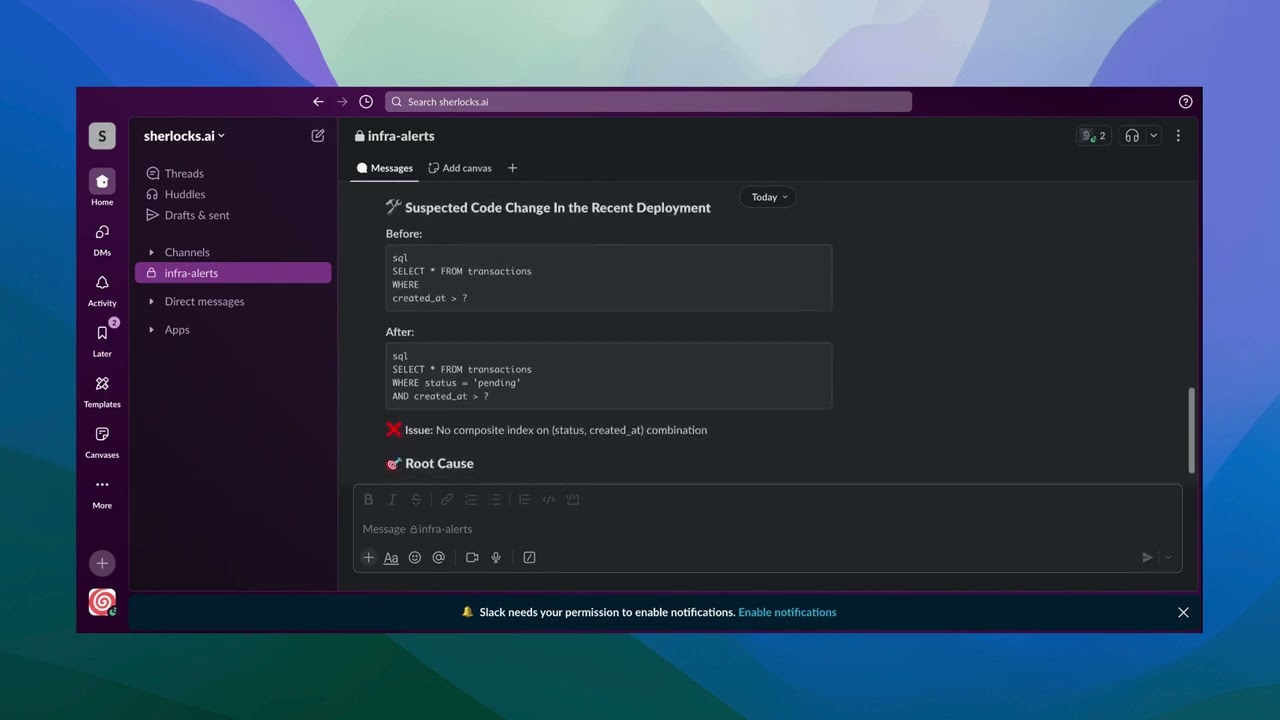
Sherlocks AI turns fragmented production signals into shared understanding. Rather than one generalist model, it dispatches 16+ domain-specialized agents in parallel, Database Sherlock, Kubernetes Sherlock and others, each investigating the part of the stack it knows best. Its data agent, Watson, runs inside your own VPC with read-only access, so raw telemetry never leaves your network. It reads whatever observability stack you already run instead of asking you to re-instrument, reports into Slack and Microsoft Teams, and holds SOC 2 Type 2 with air-gapped and in-VPC LLM deployment available for regulated environments.
Two additions in August 2026 moved work ahead of the human. Checklists let a team write down the triage it would run by hand, in its own words, and bind it to an alert type. Every matching alert then arrives with those checks already answered, each returning Normal, Inconclusive, or a finding, so a 5xx page shows up with the spike-or-plateau question, the latency of the service behind it, and what deployed in the last 30 minutes already resolved. Custom agents take a job described in plain English, turn it into a spec you approve, and then own the execution and the reporting: an hourly sweep for idle resources, a morning slow-query digest, or a check on whether a pull request adds a query no index covers.
Average time to detect across all investigations moved from 8 minutes to 6 over the same period, after agents were changed to size their reasoning to the question and to inspect the shape of a tool result before pulling the full payload. Sherlocks also reports 95% faster MTTR. Both of those are our own numbers and neither is independently audited.
Sherlocks AI builds an awareness graph that links telemetry with historical incidents and operational context, so knowledge that would otherwise be lost in chat threads or post-mortems gets reused. Checklists extend that to the triage itself: the first six things a senior engineer would check stop living in five people's heads and start running on every matching alert.
Teams where only two or three senior engineers know how to fix the recurring issues.
Free plan with 30 investigations / month, no credit card. Pro at $500 / month for unlimited investigations, first month free. Custom Enterprise pricing is also available.
Pros
- Builds a persistent awareness graph linking live telemetry with past incidents and Slack history, so repeat incidents get solved faster over time
- Lightweight setup: Watson agent deploys inside your VPC in minutes and raw telemetry never leaves your network (SOC 2 Type 2)
- 16+ domain-specialized agents (Database Sherlock, Kubernetes Sherlock, and more) run in parallel rather than one generalist LLM trying to cover everything
- Checklists run your own triage steps automatically on every matching alert, and can return Inconclusive rather than inventing an answer
- Custom agents take recurring work described in plain English and hand back a spec to approve before anything runs
Cons
- The free plan caps at 30 investigations per month, so any team with real incident volume hits that ceiling fast and has to move to a paid plan
- Value builds as it learns your environment, so teams expecting instant RCA on day one may feel underwhelmed in the first week
- Institutional memory works best for teams with good Slack hygiene and postmortem discipline; messier teams get less out of it
 2. NudgeBee: Best for self-hosted investigation with zero telemetry leaving your cluster
NudgeBee is an agentic platform for cloud operations with four assistants covering SRE, FinOps, Kubernetes ops and cloud ops. Its AI SRE runs the full loop: it plans the investigation as a dependency graph, dispatches specialist sub-agents that run real diagnostic commands against your own stack (kubectl, helm, argocd, cloud CLIs, PromQL, log and trace queries), correlates what they find against a live topology graph, and returns a root cause with the evidence and tool citations attached. Remediation is approval-gated from Slack, Microsoft Teams or Google Chat.
The whole thing runs inside your own Kubernetes cluster over a single outbound connection, with no inbound ports and no product telemetry, and the source is readable on GitHub. It pairs with your existing paging and alerting tools rather than replacing them. NudgeBee reports 70% lower MTTR and 30 to 40% lower cloud spend; both are vendor-reported.
Nothing phones home. NudgeBee is the only tool here you can read the source of, run entirely in-cluster with zero telemetry, and point at nine different LLM providers including Bedrock, Vertex AI, Azure OpenAI and a local Ollama, so there is no model lock-in and no telemetry egress conversation to have with security.
Kubernetes-heavy teams with data-residency, air-gap or cost constraints that want the investigation loop running in their own cluster, with the source open to inspection before anything executes.
Free forever for up to 2 clusters or cloud accounts, no credit card, and the source-available edition can be self-hosted in production for internal use at no cost. Paid AI SRE plans start at $2,000/month for 2 to 4 clusters.
Pros
- Self-hosted with zero telemetry and source you can read, which clears the data-residency review that stalls most AI SRE evaluations before they start
- The agent runs live diagnostic commands rather than only reading telemetry that was already collected, and it is built to reject a symptom-only answer without a causal chain and tool citations
- Genuinely free to start, free forever for two clusters, and it publishes a paid starting rate, which most of this list still does not
Cons
- Source-available, not open source. The Business Source License 1.1 allows self-hosting for internal use but blocks offering it as a managed service, and each release only converts to Apache 2.0 four years later
- Self-hosting means you run, upgrade and operate it, and the topology graph is Kubernetes-centric, so teams on VMs or serverless-first architectures get much less back for that effort
 3. Resolve.ai: Best for automating Level 1 on-call toil with approval-gated fixes
Generates remediation suggestions and proposed fixes, with human approval required for execution.
Organizations automating Level 1 support to cut repetitive on-call toil.
No public rates, contact sales only. Reported enterprise agreements run to $1M+ per year.
Pros
- Runs parallel investigations across code, infrastructure, and telemetry simultaneously rather than sequentially
- Proven at enterprise scale: Coinbase (73% faster RCA), DoorDash (87% faster investigation), Salesforce, MongoDB, MSCI, and Zscaler are all named customers
- Best-capitalized pure-play in the category, with $190M+ raised in under 18 months out of stealth and a $1.5B valuation as of April 2026, which lowers the odds of the vendor disappearing mid-contract
- Human-in-the-loop approval gates before any automated action, which matters for teams nervous about autonomous changes in production
Cons
- At $1M+/year, there is no mid-market entry point. This is purely a Fortune 500 tool
- Heavy upfront integration work required across code repos, CI/CD, and telemetry before delivering meaningful value
- Security and data handling documentation is thin publicly. You will not get clarity until you are deep in the procurement process
 4. Traversal: Best for causal root cause analysis across microservice meshes
Traversal employs causal and reasoning-based methods to analyze failures in large, distributed systems. It is designed to navigate complex dependency chains without requiring intrusive tools. Its newer Traversal Workers push the product from reactive RCA toward proactive AI SREs that act unprompted, and American Express has since come on board as both a strategic investor and a named production customer alongside DigitalOcean and Cloudways.
Focuses on rapid, causal root cause analysis that connects user-facing symptoms to upstream system failures.
Large enterprises with microservice meshes where one small upstream change cascades until manual troubleshooting stops working.
Not Available
Pros
- Causal reasoning engine built specifically for distributed systems, tracing failures across dependency chains without new instrumentation
- Non-intrusive by design: no additional agents needed in your production environment
- Particularly strong at cascading failure scenarios where a small upstream change causes downstream chaos that is impossible to trace manually
Cons
- Pricing is completely undisclosed, so you cannot assess cost-to-value without going through a full sales cycle
- Scope is narrower than full-lifecycle platforms: excellent at RCA but does not cover coordination, runbooks, or postmortems
- Less useful for teams running simpler monolithic or legacy architectures where deep causal traversal is overkill
 5. NeuBird AI (Hawkeye): Best for hybrid and multi-cloud estates keeping their existing monitoring
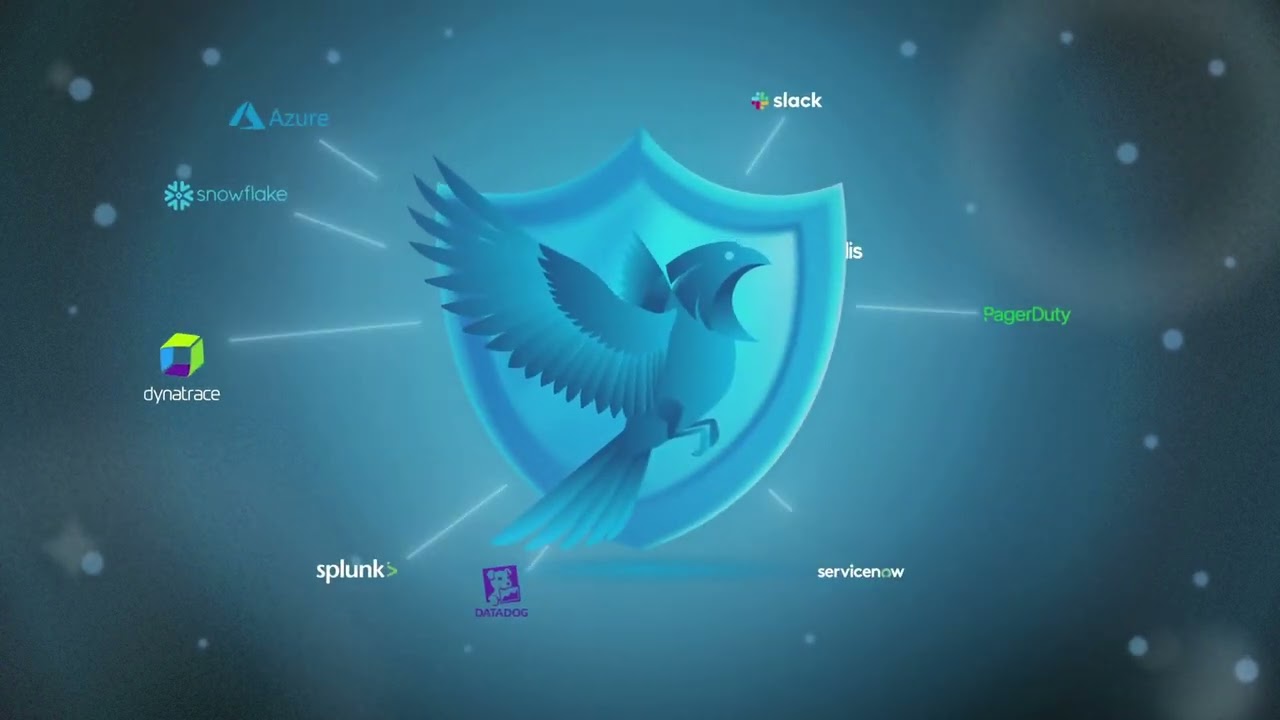
NeuBird's Hawkeye platform addresses complex enterprise and multi-cloud environments. It works with existing observability tools to assist with investigation and incident resolution. The company has since simplified its branding to NeuBird AI, launched a free self-service trial, and in April 2026 shipped Falcon, a next-generation engine it positions as roughly three times faster than the original Hawkeye.
Strong emphasis on collaborating with existing monitoring stacks rather than replacing them, especially in hybrid and multi-cloud setups.
Traditional enterprises moving to the cloud that need one safety net across hybrid stacks, AWS and on-prem together.
Free self-service trial with 50 credits, 5 users, and 1 project, no credit card. Consumption-based credits after that, sized to alert volume (roughly 100 credits/month at 1,000 alerts, 1,000 credits/month at 10,000). Custom enterprise pricing above 50,000 alerts.
Pros
- Built for hybrid and multi-cloud environments, working alongside your existing monitoring stack rather than replacing it
- Self-service free trial with 50 credits and no credit card makes it one of the easiest tools here to evaluate without talking to sales first
- Strong fit for enterprises mid-cloud migration who cannot rip and replace existing tooling overnight
Cons
- NeuBird publishes credit guidelines but no public per-credit rate, so you can size your consumption before a sales call but still cannot price it
- Less differentiated in purely cloud-native environments where purpose-built AI SRE tools offer deeper reasoning
- Fewer public case studies compared to Datadog, Rootly, or Resolve.ai, making it harder to benchmark expected outcomes before buying
 6. StackGen (Aiden for SRE): Best for enterprises running the agent under their own model-governance policy
StackGen's Aiden for SRE runs the incident lifecycle on top of the observability stack a team already has: Grafana, Prometheus, Loki, Jaeger, Datadog, Dynatrace, New Relic or Google Cloud Monitoring. It auto-discovers infrastructure across AWS, Azure, GCP and Kubernetes, triages alerts against SLOs and blast radius, and investigates through to a cited root cause that routes into Slack, PagerDuty or Jira.
On recurring incident patterns Aiden can act within a defined policy; on novel or complex ones it works the investigation alongside the on-call engineer and hands off a ranked, evidence-backed explanation. StackGen was named a sample vendor in four 2025 Gartner Hype Cycles (Platform Engineering, Site Reliability Engineering, Infrastructure Strategy, and I&O Automation) and a 2025 Gartner Cool Vendor for AI in IT Operations. Its own reliability figures, 80% less alert noise and 50% lower MTTR, are vendor-reported and not independently audited.
The deployment range is the widest on this list. Aiden runs as fully managed SaaS, as Private SaaS inside your own EKS, AKS or GKE cluster with StackGen operating it remotely, or fully self-hosted with limited-egress and air-gapped modes and your own enterprise-approved LLM endpoints. Existing runbooks become reusable Skills described in natural language rather than rebuilt from scratch, and each investigation stays a shared, auditable thread instead of a follow-up RCA doc.
Multi-cloud enterprise platform teams that need the agent running inside their own network, under their own model-governance policy, with an audit trail on every action.
Free Community Edition: one Grafana or Datadog instance, a two-person shared workspace, automated RCA, and Slack and PagerDuty routing, with no sales call. SSO, audit logs, advanced RBAC and support move to paid plans, which are quoted by sales with no public rate.
Pros
- Auto-discovers infrastructure across AWS, Azure, GCP and Kubernetes and ships 50+ pre-built RCA workflows and remediation tasks, so day one returns something without a long instrumentation project
- Widest deployment range here: SaaS, Private SaaS in your own cluster, or fully self-hosted with air-gapped and bring-your-own-LLM options, and existing runbooks become natural-language Skills rather than a rebuild
- Free Community Edition connects to Grafana or Datadog with no sales call, and it carries more analyst validation than most of this list: four 2025 Gartner Hype Cycles plus a Cool Vendor for AI in IT Operations
Cons
- No public pricing above the Community Edition, so a real budget still needs a full sales cycle
- The Community Edition caps at one observability instance and two users, and holds back SSO, audit logs and RBAC, which is exactly what an enterprise evaluation wants to test
- The value concentrates at multi-cloud, multi-team scale. A single-cloud shop pays for deployment flexibility it will never use
 7. Lightrun AI SRE: Best for unknown unknowns where logs and traces are missing
Launched in February 2026 and recognized in the 2026 Gartner Market Guide for AI SRE Tooling, Lightrun takes a fundamentally different approach to the category. While most AI SRE tools work with telemetry that was already captured, Lightrun's Runtime Context engine generates missing evidence on demand by interacting directly with live running systems, without requiring redeployments.
Lightrun can safely add logs, traces, and snapshots to production environments in real time through a patented Sandbox. Teams can prove root causes against live execution data rather than guessing from incomplete telemetry.
Teams dealing with unknown unknowns, incidents where logs are missing, traces are incomplete, or the issue was introduced by AI-generated code that behaves unpredictably at runtime.
Not available

Pros
- Only tool in this list that generates new evidence dynamically from live systems, rather than relying on what telemetry you already have
- Covers the full SDLC from pre-production through live incidents, bridging the gap between dev and ops that most SRE tools ignore
- Purpose-built for environments where AI-generated code is shipping faster than observability can keep up
Cons
- No public pricing tiers, making it hard to assess fit without going through a sales process
- The live instrumentation model requires trusting Lightrun's Sandbox security guarantees in production, which some security-conscious teams may scrutinize closely
- Newer to the AI SRE category than Datadog or Rootly, with a shorter track record at scale despite strong early customer logos
 8. Komodor (Klaudia AI): Best for large-scale Kubernetes incident resolution and cost optimisation
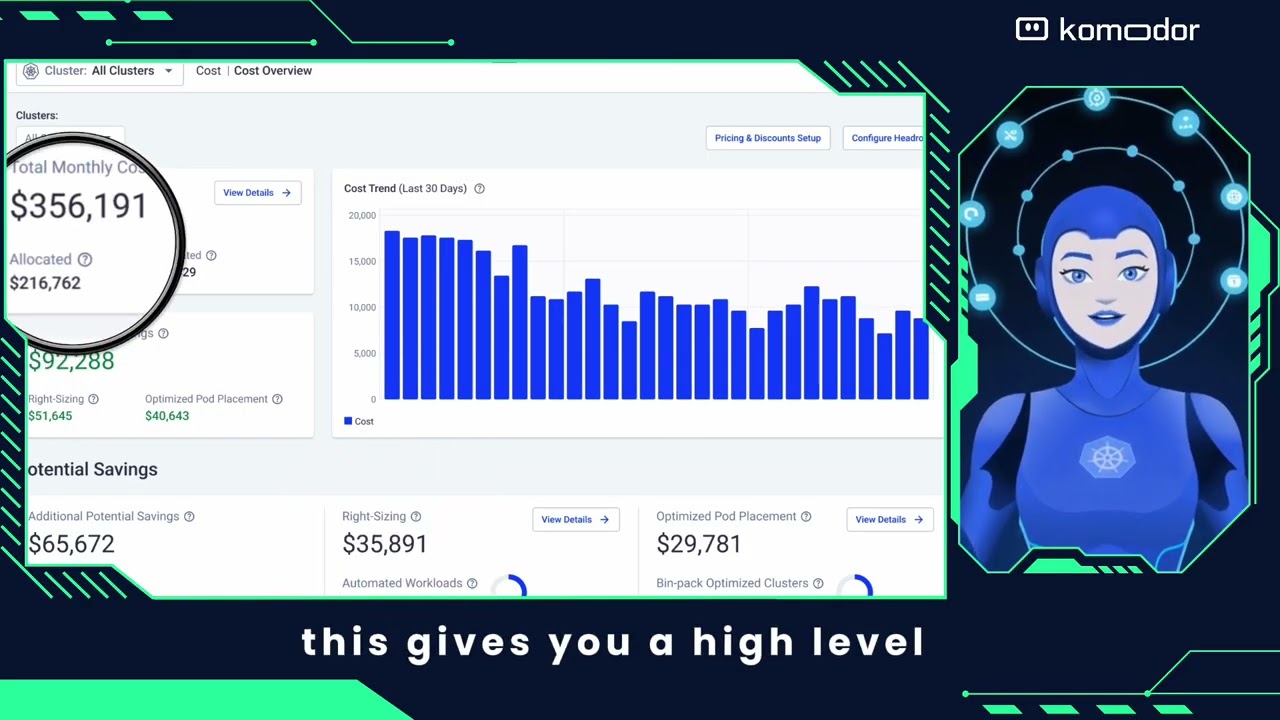
Komodor is the most Kubernetes-focused platform on this list. Its Klaudia AI agent is trained on telemetry from thousands of production Kubernetes environments and now claims 97%+ accuracy across real-world incident resolution, up from the 95% figure it launched with, alongside up to 80% MTTR reduction. The platform tripled its ARR after launching Klaudia and was named a Representative Vendor in the 2026 Gartner Market Guide for AI SRE Tooling.
Klaudia is a Kubernetes domain specialist, trained specifically on pod crashes, failed rollouts, autoscaler friction, misconfigurations, and cascading failures in cloud-native environments. It also folds cost optimization into the SRE loop, treating cloud spend efficiency as a reliability outcome.
Platform and SRE teams running large-scale Kubernetes environments who need both autonomous incident resolution and cost optimization in one platform.
No public rates. A Teams plan (up to 50 nodes, 25 users) is available with a self-serve trial, and Enterprise is custom quoted. Klaudia AI agents are included in both.
Pros
- Best-in-class Kubernetes domain expertise, trained on thousands of real production environments rather than general software engineering knowledge, and Klaudia agents are included in the entry plan rather than gated behind Enterprise
- Autonomous self-healing with configurable guardrails lets teams choose their comfort level with automation, from fully supervised to fully autonomous
- Uniquely combines reliability and cost optimization: dynamic right-sizing, intelligent pod scheduling, and workload migration are all handled by the same AI agent
Cons
- Scope is intentionally narrow. Teams running non-Kubernetes or mixed infrastructure will find limited value outside the cloud-native stack
- Pricing is not publicly available, adding friction for smaller teams trying to evaluate fit before engaging sales
- Kubernetes-only focus means it does not address the coordination, communication, or postmortem phases of incident management that broader platforms cover
These platforms bolt AI investigation onto an observability product you are already paying for. That makes the platform decision the one that really matters, because the AI inherits whatever telemetry the platform collects. If you have not settled that layer yet, work through how to choose an observability platform in 2026 before committing to any of the AI add-ons below.
 9. Datadog (Bits Investigation): Best for teams already all-in on Datadog
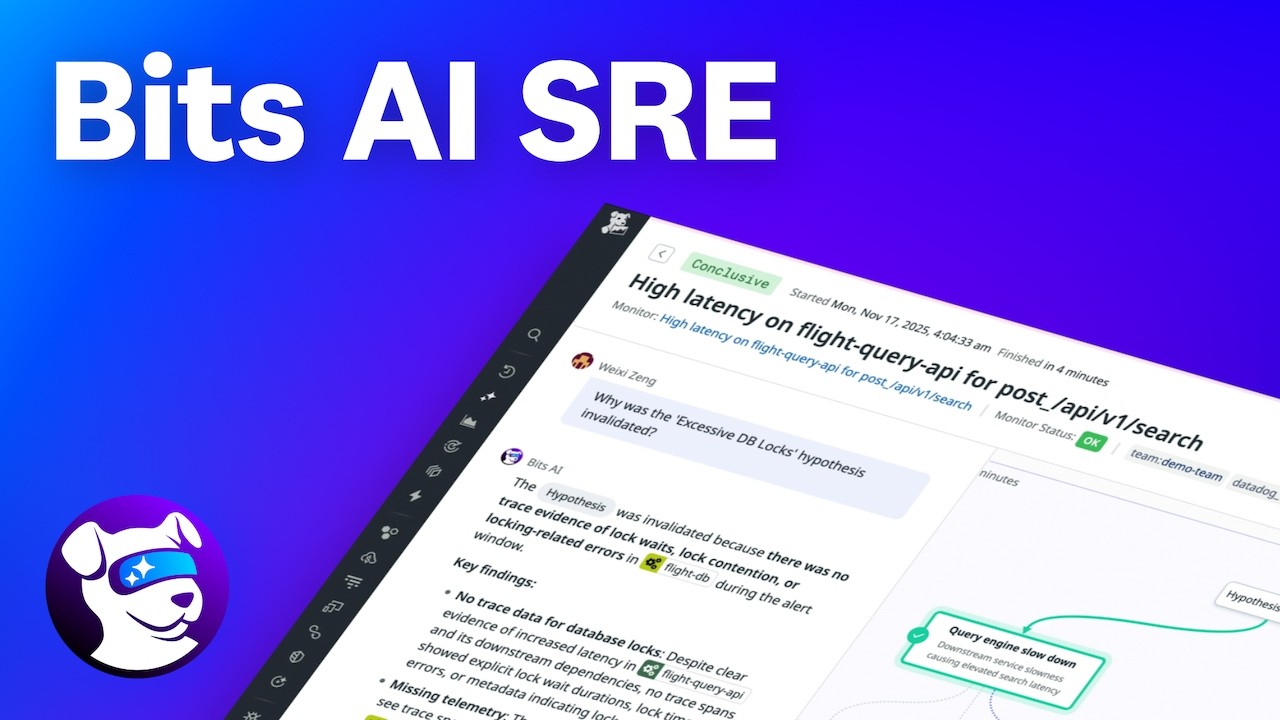
Datadog offers detailed observability across metrics, logs, and traces, with AI-assisted investigation built directly into that platform. The agent launched as Bits AI SRE and reached general availability on December 2, 2025, Datadog's first generally available AI agent. It is now branded Bits Investigation and sits alongside Bits Chat, Bits Code, and Bits Agent Builder in the wider Bits AI family. It analyzes Datadog's high-cardinality telemetry to help teams understand incidents and identify likely causes more quickly.
Offers direct, zero-context-switch access to AI-driven investigation within one of the most widely used observability platforms.
Teams already all-in on Datadog who want AI investigation without leaving the platform.
Consumption-based via Datadog AI Credits, billed per conclusive investigation (an autonomous investigation consumes roughly 6.5 credits). Credits are sold in 500-unit bundles.
Pros
- AI investigation lives inside the same platform as your metrics, logs, and traces, so there is zero context switching or new tooling to learn
- Enterprise-grade reliability, compliance certifications, and global support infrastructure that most newer entrants cannot match
- Best-in-class high-cardinality data handling, built to reason across billions of unique data points without performance degradation
Cons
- Only valuable if you are already deeply invested in Datadog. Teams on Grafana, New Relic, or mixed stacks get little benefit
- AI Credits are consumed across Bits Chat, Bits Code, and Bits Agent Builder as well as investigations, and unused credits do not roll over month to month, so high-incident-volume teams find spend hard to forecast
- The AI layer is an add-on to an observability platform, not a purpose-built investigation engine. Depth of causal inference lags behind Sherlocks AI, Traversal, or Resolve.ai
 10. Metoro: Best for Kubernetes root cause analysis without adding instrumentation
Metoro is a Kubernetes-native AI SRE platform that uses eBPF instrumentation to collect complete cluster context at the kernel level, no code changes, no container restarts, operational in under a minute.
Most AI SRE tools inherit whatever telemetry your team already configured. Metoro skips that dependency entirely. Its eBPF agent captures every call and operation across the cluster by default, giving the AI clean, complete context before investigation starts rather than noisy, incomplete signals after the fact.
Kubernetes teams that want strong AI-assisted RCA and deployment verification without adding instrumentation overhead to an already complex stack.
Free Hobby tier (1 cluster, 1 user, 2 nodes, 28-day retention). $20/node/month on the Scale plan, plus $0.20/GB beyond 100GB per node. Custom Enterprise pricing with BYOC and on-prem options.
Pros
- eBPF collection gives the AI full cluster visibility without touching application code or restarting containers
- Covers detection, RCA, alert investigation, and deployment verification in one platform
- Among the most transparent pricing on this list: free to start, $20/node/month for production, with the data overage rate published up front
Cons
- Kubernetes-only; no value for teams running non-containerized or mixed infrastructure
- Uses OpenAI models for AI features, teams with strict data residency requirements should evaluate the on-prem option before committing
- Earlier stage than Datadog or Komodor, with fewer published enterprise case studies
 11. Middleware OpsAI: Best for a unified observability stack with a configurable autonomy dial
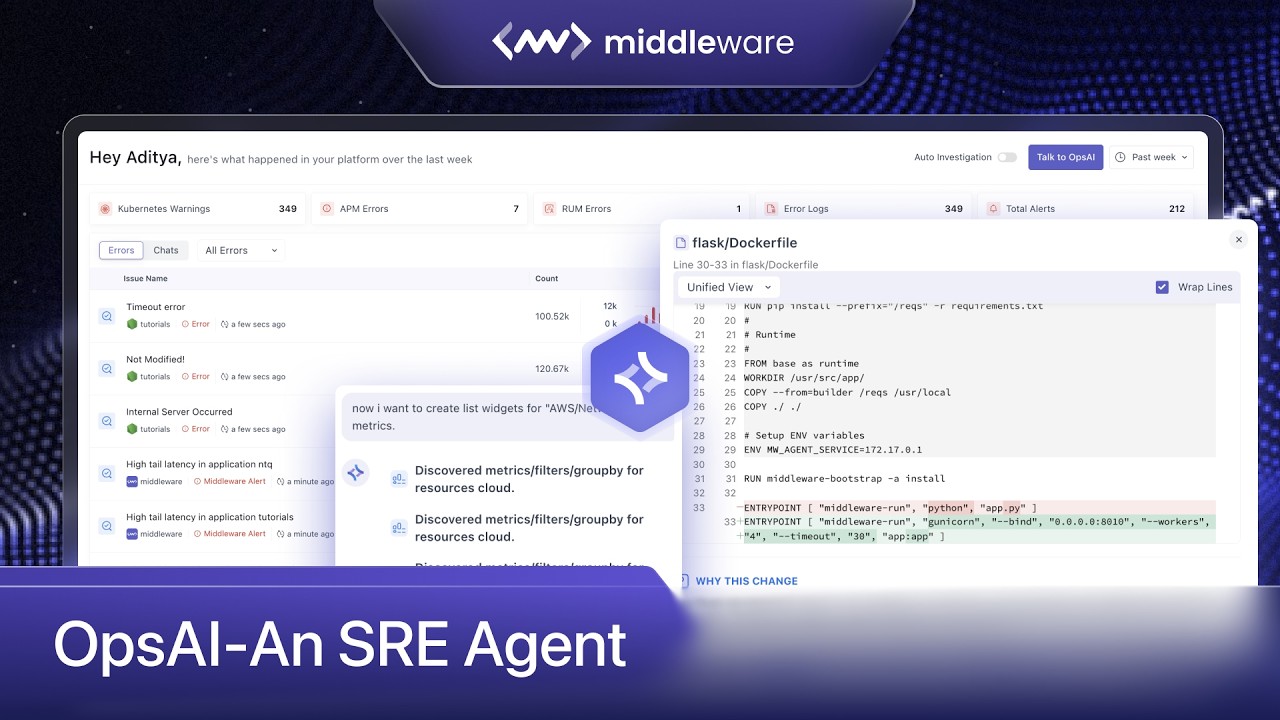
Combines full-stack correlation across backend, frontend, and telemetry down to the line of code with a configurable autonomy dial. Teams can choose Auto RCA mode (which proposes a fix as a PR) or Auto Fix mode (which applies the fix directly).
Teams willing to adopt a unified observability stack in exchange for deep, native AI remediation capabilities.
Free 14-day trial with all features, no credit card. Error detection is free; RCA and automated fixes are billed on token consumption. Underlying telemetry is pay-as-you-go from $0.30/GB for logs, metrics, and traces, with BYOC custom quoted.
Pros
- First-party access to the underlying observability stack provides deeper context than agent-layer tools sitting on third-party APIs
- Configurable autonomy gives teams control, offering both direct Auto Fix and PR-generating Auto RCA
- PR generation runs securely via GitHub MCP integration with file-scoped reads and zero source-code retention
Cons
- Reached general availability in May 2026, making it one of the newest entrants with a limited enterprise-scale track record
- Automated code-fix delivery runs through GitHub MCP only; GitLab and Bitbucket teams get the RCA loop but not auto-fix
- Token-based pricing is hard to forecast at high incident volumes, and Middleware itself notes that average token consumption per issue is a reference figure that varies with issue complexity
 12. Rootly AI SRE: Best for resolving incidents without leaving the IDE
Its Rootly MCP server plugs directly into your IDE, allowing engineers to resolve incidents without leaving their code environment.
Teams building self-healing systems that automate the whole lifecycle, from first alert to final fix.
Two-week trial, extendable. Incident Response and On-Call start at $20/user/month on Essentials. The AI SRE product is quoted separately by sales, with discounts when bundled. Eligible startups get up to 50% off.

Pros
- Covers the full incident lifecycle from detection through coordination to retrospective analytics, all in one platform with no stitching required
- IDE integration via MCP server lets engineers acknowledge, investigate, and resolve without leaving their code environment
- $20/user/month entry point for incident response and on-call makes the core platform accessible to teams of all sizes, with a generous startup discount on top
Cons
- Incident coordination and workflow automation are stronger than causal RCA. Teams whose main bottleneck is finding the root cause may need an additional investigation layer
- Works best in Slack-native environments. Teams on Microsoft Teams or other communication tools have a less seamless experience
- The $20/user/month headline covers Incident Response and On-Call only. The AI SRE product itself has no public price and requires a sales conversation
 13. AWS DevOps Agent: Best for AWS-native teams avoiding a third-party vendor
Best suited for teams already operating within AWS who want native AI-driven operations without introducing third-party tools.
AWS DevOps Agent is Amazon's purpose-built AI SRE product, now generally available. It investigates incidents by correlating telemetry, code, and deployment data across your stack. It works alongside tools your team already uses, including CloudWatch, Datadog, Dynatrace, New Relic, Splunk, GitHub, GitLab, and your incident response stack.
The agent is built on top of AWS's own infrastructure access patterns, which gives it significantly faster querying across AWS datasets than a generic LLM wrapper sitting on top of the same data. It also learns from how your team investigates incidents over time, building skills that carry forward to future incidents of the same type.
Teams running primarily on AWS who want a native AI SRE option without bringing in a third-party vendor.
$0.0083 per agent-second across investigations, evaluations, and on-demand SRE tasks, which works out to roughly $0.50 per agent-minute. Free 2-month trial for new customers and preview participants.
Pros
- Early results from preview customers are strong: 75% lower MTTR, 80% faster investigations, and 94% root cause accuracy
- Despite the name, it works across AWS, Azure, and on-premises environments via MCP
- Builds learned skills from past investigations, so the same class of incident gets faster to resolve over time
Cons
- GCP-first and heavily multi-cloud teams get much less from the AWS-native edge, since the speed advantage comes from privileged access to AWS datasets that simply does not exist elsewhere
- Per-agent-second metering means a single long-running investigation can cost far more than a short one, so spend tracks incident complexity rather than incident count and is hard to budget up front
- Recently hit GA, so the long-term track record at enterprise scale is still being built out
Comparison Table: Top AI SRE Tools in 2026
| Tool | AI Approach | Root Cause Analysis | Auto-Remediation | Best For | Kubernetes Support | OTel Native | Pricing |
|---|---|---|---|---|---|---|---|
| Sherlocks AI | LLM + 16 domain-specialized agents | Strong, awareness graph links telemetry with historical incidents | Remediation recommendations with human approval | Teams with siloed knowledge and recurring incidents | Yes, dedicated Kubernetes Sherlock agent | Yes | Free tier; $500/month unlimited |
| NudgeBee | Planner plus specialist sub-agents running live diagnostic commands | Strong, causal chain with tool citations against a live topology graph | Approval-gated remediation from Slack, Teams or Google Chat | Teams that must keep the whole loop inside their own cluster | Yes, Kubernetes-native across AWS, Azure and GCP | Yes | Free for 2 clusters; from $2,000/month |
| Resolve.ai | Multi-agent LLM with parallel investigation | Strong, cross-stack RCA across code, infra, and telemetry | Suggested fixes with mandatory human approval | Fortune 500 teams automating Level 1 on-call toil | Yes, full infra coverage including K8s | Partial | $1M+/year |
| Traversal | Causal reasoning engine | Strong, purpose-built causal RCA for distributed dependency chains | Investigation only, no automated remediation | Large microservice meshes with cascading failures | Yes, designed for distributed cloud-native systems | Not disclosed | Not available |
| NeuBird AI (Hawkeye) | LLM layer on existing monitoring tools | Moderate, limited by your existing observability setup | Guided suggestions, not autonomous execution | Hybrid and multi-cloud enterprises mid-migration | Partial, via existing monitoring integrations | Partial | Free trial; consumption credits |
| StackGen (Aiden for SRE) | Agentic AI over your existing observability stack | Strong, cited RCA with blast-radius and SLO-aware triage | Policy-bound autonomy on recurring patterns, approval required otherwise | Multi-cloud enterprises needing private, self-hosted or air-gapped deployment | Yes, plus AWS, Azure, GCP, databases and message queues | Partial, via Prometheus, Grafana and vendor integrations | Free Community Edition; paid quoted by sales |
| Lightrun AI SRE | Runtime context engine with live instrumentation | Strong, proves root cause against live execution data, not static telemetry | Runtime-validated fixes and automated remediation suggestions | Teams debugging AI-generated code and unknown unknowns | Yes, live runtime context across containerized environments | Partial | Not available |
| Komodor (Klaudia AI) | Kubernetes-specialist agents trained on production telemetry | Strong, 97%+ vendor-reported accuracy on Kubernetes-specific failures | Autonomous self-healing with configurable human-in-the-loop guardrails | Platform teams running large-scale Kubernetes at enterprise | Yes, Kubernetes only, best-in-class | Partial | Custom pricing |
| Datadog (Bits Investigation) | LLM add-on within Datadog platform | Moderate, best within Datadog telemetry, limited outside it | Workflow suggestions only, no autonomous execution | Teams fully committed to the Datadog ecosystem | Yes, native Kubernetes monitoring and analysis | Yes | AI Credits, per conclusive investigation |
| Metoro | eBPF kernel-level telemetry + LLM reasoning | Strong, complete eBPF context enables cleaner causal RCA | Deployment verification and remediation suggestions with evidence | Kubernetes teams wanting zero instrumentation overhead | Yes, Kubernetes only, eBPF-native | Yes (OTel + eBPF) | Free; $20/node/month |
| Middleware OpsAI | Agentic AI built on first-party observability stack | Strong, full-stack correlation across backend, frontend, and telemetry down to the line of code | Configurable: Auto RCA (proposes a PR) or Auto Fix (applies the fix directly) | Teams wanting deep, native AI remediation on a unified observability stack | Yes, deep integration via first-party telemetry | Yes | Usage-based, free 14-day trial |
| Rootly AI SRE | LLM-native incident management platform | Moderate, stronger on coordination than deep causal investigation | Full lifecycle automation from alert to retrospective via MCP | Teams automating the entire incident lifecycle end to end | Yes, Kubernetes alert routing and triage supported | Yes | From $20/user/month; AI SRE quoted separately |
| AWS DevOps Agent | Agentic AI with AWS-native telemetry correlation | Strong: 94% root cause accuracy in preview, learned skills improve over time | Autonomous investigation with human-approved remediation | Cloud-native teams in the AWS ecosystem wanting native AI SRE without third-party tools | Yes, deep AWS EKS and container support | Partial, works with OTel via integrations | $0.0083/agent-second; free 2-month trial |
Are There Open Source AI SRE Options?
Yes, but the honest answer is that no single open source project gives you what the commercial tools above do out of the box. What you get instead is a set of components you assemble and maintain yourself.
Most teams start with Prometheus for metrics, Grafana for visualization and alerting, and OpenTelemetry for collecting logs, metrics, and traces without locking into a specific vendor. SigNoz sits on top of that as an open source alternative to Datadog, bringing all three signals into one interface with an AI layer that is still maturing.
The trade-off is straightforward. You keep full control of your data, avoid licensing costs, and stay vendor-neutral. In return, you take on the work of running, integrating, and maintaining all of it. Adding an actual AI reasoning layer on top, typically via OpenAI or an open source LLM, requires more engineering investment than most teams plan for upfront.
This approach works well for teams with strong platform engineering capacity, strict data residency requirements, or budget constraints that rule out commercial tools. If your main bottleneck is investigation speed rather than cost, a commercial tool will get you there faster. In practice, open source AI SRE works best for teams with strong platform engineering capabilities who prefer flexibility over out-of-the-box automation.
How We Evaluated These AI SRE Tools
We did not build this list from vendor marketing pages or G2 reviews. We build and run an AI SRE platform ourselves, so we tested every tool the way a skeptical SRE would: by pushing the claims against real production scenarios. Five criteria decided the rankings.
Causal depth, not correlation
Can the tool explain why something broke, or only flag that it did? Anything that surfaces symptoms without tracing them to a root cause scored lower, however polished the interface.
Honest autonomy claims
Plenty of tools market autonomous remediation but need heavy manual setup before it works. We flagged that gap everywhere we found it.
Pricing transparency
Hidden pricing is a friction signal. We recorded exactly what is public and called out every tool where you need a sales cycle just to get a number.
Integration realism
What does day one actually look like? Tools that need months of instrumentation before they return anything useful were marked down.
Kubernetes and cloud-native fit
Over 60% of SRE teams now run containerized workloads, so we measured how deep each tool goes on Kubernetes rather than whether it ticks the box.
On our own conflict of interest
We run Sherlocks AI across many customer environments, which is where our ground-level view of what works comes from. It also means we are not a neutral party. So we held our own tool to a stricter standard and gave it the same honest cons treatment as every other platform here.
Last reviewed: Aug 27, 2026
How to Choose the Right AI SRE Tool
Identify Your Primary Operational Bottleneck
Before looking at tools, figure out where your team spends the most time during an incident. McKinsey research on AI operations shows that leading organizations achieve 3.8x better performance improvement than laggards when implementing AI in operations - making tool selection critical. If you are not sure where that time actually goes, our RCA guides break down the common production failure modes and our worked investigation examples show the full evidence trail on real incidents. Two gaps account for most of it:
You spot issues fast but burn hours linking logs and traces by hand to work out why. Prioritize tools built for reasoning and root cause analysis.
If your main challenge is managing communication, updating stakeholders, and following runbooks, look for tools that highlight Orchestration and Guided Workflows.
Match the Tool to Your Architecture, Not Your Headcount
In 2026, the best tool depends on how complex your system is, regardless of your team size:
Complex setups fail in cascades. You need causal reasoning that can follow a single request across service boundaries.
Simpler architectures have clearer failure points, so deep agentic traversal is overkill. Tools that speed up data retrieval and summarization fit better.
Check How It Handles Your Existing Data
AI performs best with the right data. Assess tools based on how they deal with your current stack:
Seek tools that work with your existing telemetry (OpenTelemetry, Prometheus, etc.) without requiring new, proprietary agents.
Ensure the tool can reason across billions of unique data points (like Request IDs or User IDs) without slowing down or becoming prohibitively costly.
Define Your Comfort Level with Autonomy
Clarify how much autonomy you want:
The AI runs the investigation and hands the engineer a written briefing. The engineer decides on the fix.
The AI is allowed to suggest and, with approval, carry out fixes (like rolling back a deployment or scaling a cluster).
Regardless of the model, the tool must provide Explainability, it should show the exact evidence trail used to reach its conclusion.
Evaluate Institutional Memory vs. Static Knowledge
The real test of an AI SRE tool comes during a repeat incident:
A 2026-ready tool shouldn't only look at real-time metrics; it should include your past post-mortems, Slack discussions, and Jira tickets.
You want a system that builds a knowledge graph of your environment, so it can match today's incident to one from six months ago and surface the fix that worked.
Red Flag Checklist
Avoid tools that:
- Hallucinate RCA without evidence
- Hide pricing behavior under load
- Require manual labeling to learn
Conclusion
AI SRE is the bridge between how fast humans can think and how fast machine-generated code now ships. These tools are not a threat to your job. They take manual log analysis off your plate so you can go back to designing systems instead of grepping them.
We must embrace this change because AI provides the speed to investigate in parallel while humans deliver the causal intuition and ethical judgment that no model can replicate. Ultimately, collaborating with AI doesn't replace the SRE, it empowers you to lead a more resilient, autonomous ecosystem without the strain of traditional on-call work. To understand where this is all heading, explore our perspective on the future of AI-powered incident management and how it's transforming reliability engineering.
The shift is no longer just toward better observability. It is toward systems that can detect, diagnose, and resolve issues on their own.
Which AI SRE tool is right for your stack?
SRE tools: what a 2026 stack actually needs
A working stack covers four jobs, and investigation is the one that decides your MTTR. Cover it with Sherlocks AI, NudgeBee or Traversal. Detection comes from Datadog, Prometheus with Grafana or New Relic. Routing from PagerDuty or ilert. Learning from Rootly or incident.io. Most teams over-invest in detection and routing and leave investigation manual, which is why MTTR stays flat while the tooling budget grows. Audit where your own incident minutes go before adding another SRE tool.
What are the best AI SREs?
Judged on causal reasoning, remediation maturity and Kubernetes support, the strongest in 2026 are Sherlocks AI for investigation that carries memory of past incidents, NudgeBee for teams needing the loop self-hosted, Resolve.ai for automating Level 1 on-call toil, Traversal for causal analysis across microservice meshes, and Komodor for large-scale Kubernetes. There is no single best. The right pick follows your architecture and your data-residency constraints more closely than any feature list.
Comparing AIOps and AI SRE platforms
AI SRE platforms investigate a specific incident and propose a cause, which is where Sherlocks AI, Traversal and NeuBird sit. AIOps platforms cluster and de-duplicate alerts to reduce noise, which is where PagerDuty AIOps and Datadog Watchdog sit. AI SRE answers why this one fired; AIOps answers which alerts matter. They are complementary rather than competing. Teams running both usually find the AIOps layer shrinks the queue while the AI SRE layer shortens each remaining incident.
AI SRE pricing models in 2026
Five models are in play. Flat subscription, which is how Sherlocks AI prices: a free plan of 30 investigations a month, then $500/month for unlimited ones. Per-host or per-node, used by observability-native tools such as Datadog and Komodor. Per-incident or per-investigation, common among the investigation-first vendors. Per-seat for engineers on call. And self-hosted with no licence, which NudgeBee offers by running entirely in your cluster. Compare on cost per incident rather than list price, since a per-host model gets expensive on a large fleet however often you use it.
Which is the best AI SRE for EKS?
On EKS, Sherlocks AI investigates the cluster alongside the services and databases around it, so a Kubernetes symptom and an upstream cause land in one investigation rather than two tools. The Kubernetes specialists go deeper inside the cluster itself. Komodor's Klaudia is trained on pod crashes, failed rollouts and autoscaler friction. Metoro captures calls through an eBPF agent, so it works without adding instrumentation to an already complex cluster. NudgeBee runs in-cluster with no telemetry leaving your account, which suits data-residency constraints. StackGen can run as Private SaaS inside your own EKS cluster.
Frequently Asked Questions
There is no single best AI SRE tool. The right one depends on which part of incident response is slowest for your team. Traversal is strongest on causal root cause analysis across large microservice meshes. Komodor and Metoro are the Kubernetes specialists. Rootly AI SRE covers the full incident lifecycle from alert to retrospective. Datadog Bits Investigation is the lowest-friction option for teams already standardized on Datadog. Sherlocks AI is built for teams where the same incidents keep recurring because the fix lives in two or three engineers' heads. AWS DevOps Agent is the native choice for AWS-centric stacks. StackGen's Aiden suits multi-cloud enterprises that need the agent inside their own network under their own model-governance policy, and NudgeBee is the self-hosted, source-available option for teams who have to keep the whole loop in-cluster. Shortlist on causal depth, Kubernetes fit, pricing transparency, and how much work day one actually takes. Our worked investigation examples show what a full evidence trail should look like before you commit to any vendor.
Of the platforms covered in this guide, Rootly AI SRE handles automated workflow coordination across the full incident lifecycle, and Sherlocks AI adds contextual investigation and institutional memory. PagerDuty and incident.io are strong in this category too, but they sit outside the AI-native scope of this list, so we cover them in our broader Best DevOps Tools for 2026 guide instead.
AI SRE tools are particularly effective for incidents involving complex distributed systems, performance degradations, deployment-related failures, and recurring issues with known patterns. They excel at correlating signals across logs, metrics, and traces to identify root causes like resource contention, configuration drift, database locks, or cascading service failures. AI SRE works best as an assistant, not a replacement: it runs parallel investigation and data analysis while humans supply judgment on novel incidents and anything needing business context.
An AI SRE is an intelligent system that uses large language models and reasoning engines to detect, investigate, and help resolve production incidents, essentially acting as a digital teammate rather than a replacement for human SREs. While human SREs provide strategic thinking, business context, and ethical judgment, AI SREs handle the toil: analyzing thousands of metrics simultaneously, correlating disparate signals, and surfacing historical incident patterns. Being an SRE is inherently chaotic, and AI SREs address that chaos by maintaining perfect memory of every incident and executing parallel investigations.
AI SRE tool pricing in 2026 splits into three bands. Free and entry tiers now exist across the category: Sherlocks AI has a free plan covering 30 investigations per month, Metoro is free for a single small cluster, NudgeBee is free forever for up to two clusters or cloud accounts, and StackGen ships a free Aiden for SRE Community Edition on one Grafana or Datadog instance. Mid-tier sits in the hundreds to low thousands per month, with Sherlocks AI Pro at $500/month for unlimited investigations, NudgeBee AI SRE from $2,000/month for two to four clusters, and Rootly from $20/user/month. Enterprise agreements reach $1M+/year, with Resolve.ai at the top of that range. The clear 2026 trend is consumption pricing: Datadog moved Bits Investigation onto AI Credits billed per conclusive investigation, NeuBird sells prepaid credits, and AWS DevOps Agent meters at $0.0083 per agent-second. The ROI typically comes from reducing MTTR and eliminating repetitive on-call toil.
Major observability platforms have integrated AI-assisted incident response capabilities: Datadog offers Bits Investigation, the agent that launched as Bits AI SRE and is natively integrated with Datadog telemetry, New Relic provides AI-powered anomaly detection, and traditional monitoring tools increasingly partner with specialized AI SRE platforms. However, purpose-built AI SRE tools like Sherlocks AI and Resolve.ai often provide deeper reasoning capabilities because they are designed specifically for investigation rather than just data collection, with a focus on causal inference and contextual awareness.
Both are AI-native SRE platforms, but they take different approaches. Resolve AI focuses on AIOps with pattern detection, while Sherlocks AI uses LLM reasoning for natural language investigation. For a full breakdown of features, pricing, and use cases, check out our Resolve AI vs Sherlocks AI comparison.
Start by identifying your biggest bottleneck, detection, investigation, or coordination. If incidents are hard to find, prioritize an observability layer like Datadog or Grafana first. Once you have signal coverage, layer in an AI SRE tool like Sherlocks AI to handle investigation and root cause analysis on top of that existing telemetry.
AIOps is the broader category, it covers using AI across all IT operations including infrastructure management, event correlation, and capacity planning. AI SRE is a narrower, more focused discipline that applies AI specifically to production reliability: detecting incidents, investigating root causes, and reducing MTTR. Think of AIOps as the umbrella and AI SRE as the sharpest tool inside it.
Yes, several. Sherlocks AI has a free plan covering 30 investigations a month with no credit card. NudgeBee is free forever for up to two clusters or cloud accounts and can be self-hosted in production for internal use at no cost. StackGen ships a free Aiden for SRE Community Edition that connects to one Grafana or Datadog instance with no sales call. Metoro has a free Hobby tier for a single small cluster, NeuBird gives 50 self-service credits, Middleware runs a 14-day full-feature trial, and AWS DevOps Agent has a two-month free trial for new customers. Traversal, Lightrun, Komodor and Resolve.ai all require a sales conversation before you see a number.
Yes, and in 2026 it separates the list more than any other criterion. NudgeBee runs entirely inside your own Kubernetes cluster with zero telemetry, no inbound ports and source you can read, and supports air-gapped operation across nine LLM providers. StackGen offers Aiden as Private SaaS inside your own EKS, AKS or GKE cluster or fully self-hosted, with limited-egress and air-gapped modes and bring-your-own-LLM endpoints. Sherlocks AI runs its Watson data agent inside your VPC with read-only access and offers air-gapped and in-VPC LLM deployment. Metoro and Middleware publish BYOC and on-prem options. Datadog Bits Investigation and AWS DevOps Agent are SaaS by design.
Not necessarily. Tools like Datadog and Dynatrace already include AI for monitoring and alerts, but AI-native SRE tools go further into automated debugging and remediation. The need depends on how much automation vs visibility your team requires.
Related Reading
PagerDuty vs New Relic vs Datadog vs Sherlocks AI
Tested on the same production incident. See which platform found the root cause fastest.
Best Incident Response Platforms for DevOps (2026)
The four-layer IR stack framework and how to choose tools for each layer.
Claude Code vs. Sherlocks AI
Can a general-purpose AI agent replace a dedicated AI SRE platform? An honest comparison.
Vibe SRE vs Agentic SRE
Why how you use AI for SRE matters more than which model you choose.
Upgrade Your SRE Stack Today
Stop wasting time on manual correlation and tool sprawl. See how Sherlocks AI turns fragmented signals into actionable insights in minutes.
Book a Demo